Valuables in Crisis: What Really Counts
As of: 29.09.2026
That changes with the duration of the crisis. Early (hours to days) cash in small denominations, drinking water, light, fuel and a battery-powered radio count. Late (weeks to months) medicines, hygiene, barter goods and practical skills come to the fore. In a currency devaluation like in Venezuela, cash itself loses its value – then material assets and barter trade matter.
The value of a good depends not on the price tag, but on the situation. In a normal week, money counts; in a crisis, it counts what money cannot buy right now. This order shifts with time: in the first hours, cash in small denominations, drinking water, light, fuel and information are in demand; after weeks, medicines, barter goods and practical skills. In the extreme case – as in Venezuela between 2016 and 2021 – money itself loses almost all its value. This article puts this value shift into sober context. It is not investment advice, but a preparedness perspective: whoever understands what becomes scarce when, prepares more deliberately. It is about provision, not panic.
Why values shift in a crisis
Value is relative. It depends on how scarce a good is in relation to demand. In everyday life, a litre of water is practically free and a full tank a matter of course. If supply fails, that reverses: things that were worthless yesterday become a bottleneck – and things that were thought secure (such as the balance on a bank card) suddenly become inaccessible.
The time axis is crucial. People only gradually recognize that a problem has a larger scope. That is why the "value" of goods shifts in stages: first, what bridges the initial shock is hoarded (cash, water, light), later, what offsets prolonged scarcity (medicines, barter goods, skills).
Two very different crisis types must be distinguished. In a supply crisis (e.g. a prolonged power outage), the Swiss franc retains its value – only the goods become scarce. In a currency crisis (hyperinflation, currency collapse) money itself loses its value; then material assets and barter trade matter. For Switzerland, the first case is the realistic preparedness perspective; the second is more of a historical lesson.
Money can become worthless: the example of Venezuela
Venezuela experienced hyperinflation from around 2016 to the end of 2021 – over four years in which prices doubled multiple times per month. At the peak in 2018/2019, annual inflation was in the order of several hundred thousand to over one million per cent (estimates vary widely depending on source – the International Monetary Fund cited roughly 930,000 per cent for 2018, the opposition National Assembly roughly 1.7 million per cent). No exact figure exists; only the magnitude is documented.
In practical terms: cash lost its value faster than it could be spent. The state removed over the years a total of 14 zeros from the currency through three currency reforms (2008, 2018, 2021). People resorted to US dollars – by September 2019, around 50 % of all transactions in the country were conducted in dollars – and to barter (Spanish *trueque*): fish for flour, service for food.
For those wanting to go deeper: journalist William Neuman, long-time Andes correspondent for the New York Times, has documented the collapse in a non-fiction book: *Things Are Never So Bad That They Can't Get Worse: Inside the Collapse of Venezuela* (St. Martin's Press, 2022). It describes hyperinflation, supply shortages and everyday life in economic collapse at first hand.
Context for Switzerland: such a collapse is highly unlikely here – the Swiss franc is considered a stable currency. Venezuela is therefore not a doomsday scenario for daily life, but a lesson that "value" is not fixed. The practical lesson is sober: having some cash at home makes sense (see §3 emergency supplies) – but wealth protection against currency devaluation is a question of financial planning and not the subject of this article.
When everyday goods suddenly become scarce: toilet paper in 2020
State collapse isn't needed for values to shift – a headline is enough. In spring 2020, shelves in Switzerland too were emptied, especially of toilet paper, but also of flour, yeast, pasta, rice, tinned goods and disinfectant. Hefe Schweiz AG produced six times its usual volume in the third week of March.
How severe the wave was is shown by scanner data from Germany's federal statistics office (no published weekly figures per product exist for Switzerland): toilet paper sales in the week of 16 to 22 March 2020 were 211 % above the average of the preceding six months, soap 337 %, disinfectant even 751 % a week earlier. Three weeks later, toilet paper sales were 29 % below normal. Households had therefore not consumed more, just bought earlier.
Migros and Coop stressed that warehouses were full; all food retailers ran a joint advert on 16 March 2020: "Panic buying is completely unnecessary." Switzerland did not officially ration – retailers, in coordination with FONES, prioritised a basic assortment.
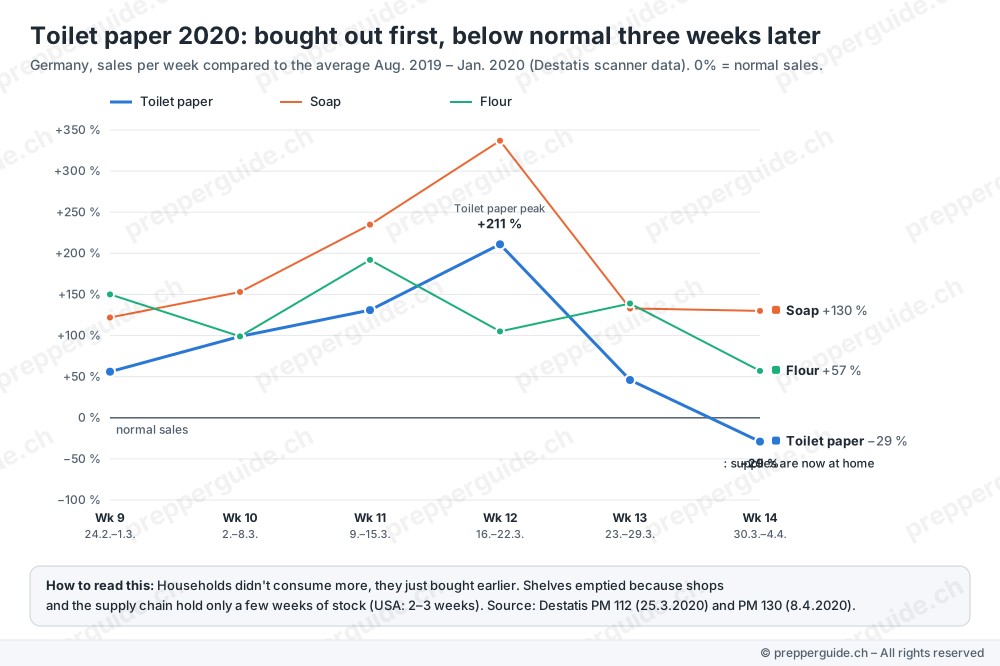
Why toilet paper of all things? The mechanics of a panic wave
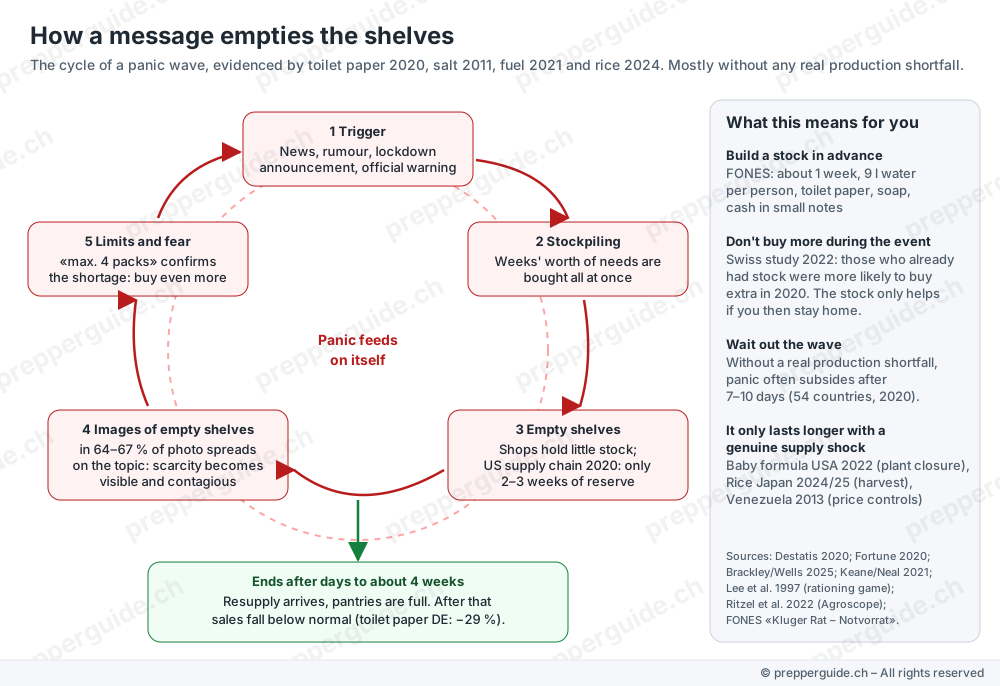
Factories kept running in 2020. Toilet paper became scarce for several reasons at once: shops and supply chains hold only small stocks (around two to three weeks in the US), the product is bulky and cheap and therefore restocked sparingly, and anyone at home instead of in the office or at school genuinely needs more household rolls. Commercial rolls can't simply be redirected.
Psychology adds to this. The wave isn't caused by a few extreme buyers, but because many households buy a little more at the same time – purchase quantity limits therefore barely help. Images of empty shelves make the scarcity visible and reinforce it. What best explains who hoards is the feeling of threat; personality plays only a small role.
Such waves are short: a study across 54 countries found that panic largely subsided about 7 to 10 days after a lockdown announcement. Without an actual production failure, shortages last days to a few weeks. They last months only in the case of a genuine supply shock – such as infant formula in the US in 2022, when a plant with around 40 % market share went offline.
The pattern isn't new: Japan experienced a toilet-paper panic in 1973 without any paper shortage, China a run on salt in 2011, supposedly protective against radiation (it isn't), Britain empty petrol stations in 2021 without a fuel shortage.
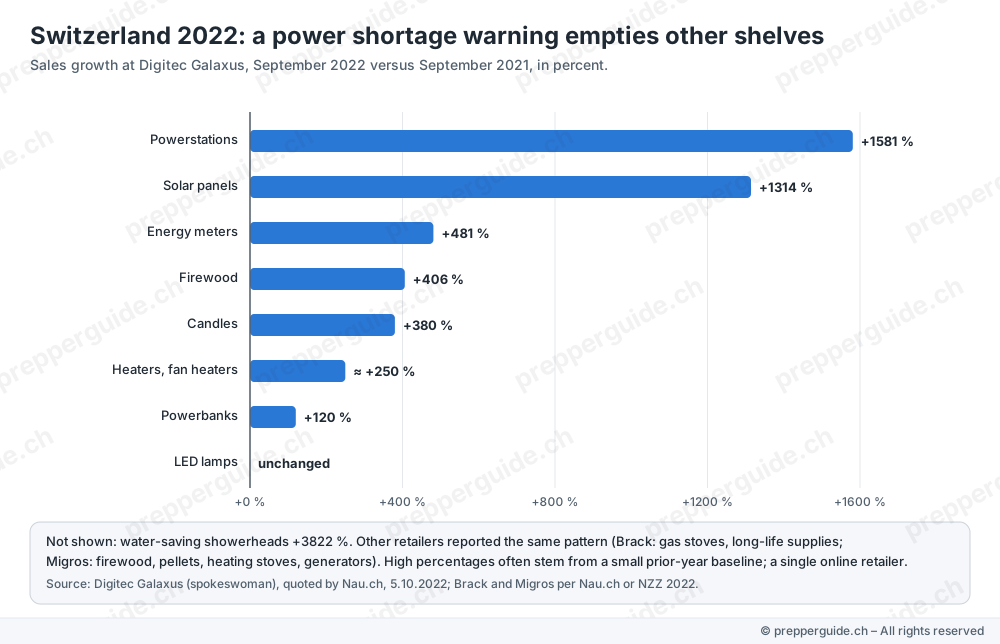
Switzerland in 2022: candles, firewood and power stations
The same pattern showed up in autumn 2022, when a possible electricity shortage was warned about. A large online retailer reported in September 2022, against the same month the year before, power stations up 1581 %, firewood up 406 % and candles up 380 %. Pellets rose in price within a year from around 400 to around 650 francs per tonne. After the fighting around Ukraine's Zaporizhzhia nuclear power plant, many asked pharmacies for iodine tablets.
The electricity shortage did not happen. The lesson is the same as in 2020: whatever gets mentioned in a warning becomes scarce – not because it's missing, but because everyone buys at the same time.
Scarce in the shop is not the same as valuable
In 2020, toilet paper was occasionally bartered for eggs or paper towels, and offers at extortionate prices appeared online – the platforms deleted them. Toilet paper did not become a real barter good: money kept working, and within a few weeks the shelf was full again.
In long crises, other goods had barter value: cigarettes and tobacco, alcohol, tinned food, candles, fuel, eggs and staple food. What they have in common is that they are durable, uniform, divisible and sought after almost everywhere – and that they aren't reproduced within a few weeks. Barter value also only arises once money stops working or shops stay empty permanently. How barter, commodity money and other systems then work is explained in the article "Alternative Trade Systems in a Crisis."
Switzerland has already been through this: stockpiling and rationing 1939-1948
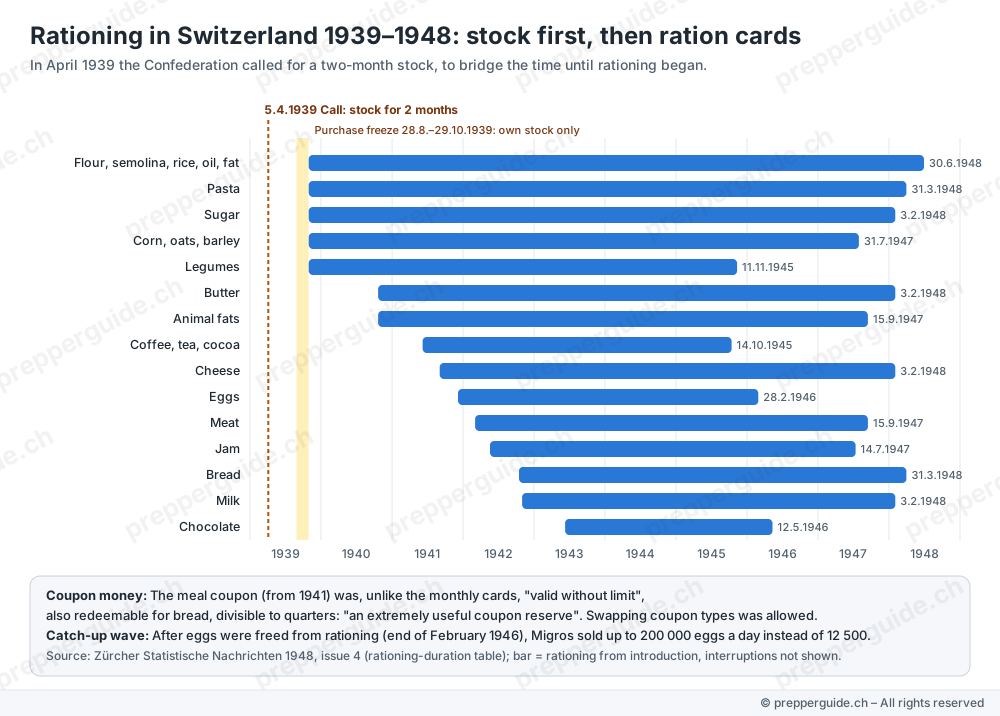
On 5 April 1939, the federal Department of Public Economy called on households to build a two-month stock. At the outbreak of war, a sales freeze followed from 28 August to 29 October 1939: important foodstuffs could no longer be sold, and households lived off their stocks until rationing took effect. The stock was therefore the bridge – the direct forerunner of today's emergency supply.
At the same time, hoarding was banned. A Federal Council decree of 1 September 1939 targeted "hoarding, profiteering, black-market and chain transactions"; banned, among other things, was "buying up goods domestically, stockpiling domestic goods, anything beyond normal ongoing needs." Preparedness beforehand was welcomed, stockpiling afterwards was banned.
Rationing of flour, rice, oil and fat lasted until the end of June 1948. Up to 700 million coupons were in circulation nationwide each month; they only conferred a right to buy, and payment continued to be made in francs. The meal coupon, valid without a time limit and divisible down to a quarter, became a kind of second currency, and the federal government allowed exchange between coupon types. Despite the "Battle for Cultivation" campaign, an average Zurich consumer in 1945 had only around 1977 instead of the required 2160 calories per day.
When eggs were freed from rationing in February 1946, Migros sold up to 200,000 eggs a day instead of 12,500 – even the end of a shortage triggers a buying wave.
The shift in values over time
The longer a crisis lasts, the more what is needed shifts. Roughly and as a plausible illustration (not an official forecast): in the first hours and days, what bridges the shock matters – cash in small denominations (because ATMs and card terminals fail in a power outage), drinking water, light and batteries, fuel and a battery-powered radio for information.
After days to weeks, cooking facilities, hygiene, a reliable energy source and replacements for perishables move to the fore. After weeks to months, medicines and medical care, barter goods and practical skills (repair, cooking, provisioning) matter most – things that cannot be bought quickly.
The exact sequence in the timeline (§5a) is an experience-based illustration, not a ranking published by an authority. Individual building blocks are documented (e.g. that cash becomes important in a power outage because card payment fails); the temporal sequence is a plausible synthesis to help you plan your stock more deliberately.
What this means for your preparedness
Official Swiss preparedness already covers the early phases. The Federal Office for National Economic Supply (FONES) recommends an emergency stock for about one week: among other things 9 litres of drinking water per person, shelf-stable food, a battery-powered radio with spare batteries, torch and candles, toilet paper and soap, personal medicines and enough cash in small notes to pay for a week's shopping and, if necessary, a tank of fuel in cash. That is the concrete, sober answer to the abstract value shift.
Almost everything that became scarce in 2020 and 2022 is already on this list. But the stock only helps if you stay home during the wave: a Swiss study by Agroscope found that households who already held an emergency stock beforehand were, if anything, more likely to buy extra during the 2020 lockdown. At the same time, almost half the population (48 %) has too little stock or none at all. Preparedness therefore means both: building the stock in advance and not buying extra during the event.
For beginners: start with the official weekly stock (water, shelf-stable food, radio, cash, medicines). With that you are well equipped for the most common and likely situations – power outage, supply disruption. Nothing more is needed to start.
Expert tip: think in time horizons rather than product lists. For the late phases, deliberately check what cannot be replaced quickly in your household: prescription-only regular medicines (discuss reserve stock with your doctor), spare glasses, special food, spare parts. Barter goods and skills are not a replacement for basic stock, but a supplement for long crises. Keep cash in small denominations – in an event, no one can change large notes.
Common misconceptions
- "I have money, so I am provided for" – money is useless if ATMs and card terminals are without power or shelves are empty. Value arises from availability, not from account balance.
- Only go shopping at the first sign of a crisis – then the shelves are already empty (Corona 2020). Preparedness only works if it is already there.
- Only think about the first phase (water, light) and forget medicines, hygiene and longer-lasting solutions – precisely these become hardest to replace in long crises.
- Keep cash only in large notes – in an event, no one can change them; small denominations count.
- Derive an investment "strategy" from the Venezuela or hyperinflation example (gold, crypto, foreign currency as speculation). That is financial planning, not emergency stock – and not the topic of this article.
- Hoard barter goods instead of covering basic needs – bartering is a phenomenon of long crises, not the starting point of preparedness.
- Stock up out of fear rather than plan deliberately – panic buying creates the scarcity you fear.
- Buy extra during the wave despite a full stock – that's exactly what many well-prepared households did in 2020 (Agroscope). The stock only helps if you then stay home.
- Hoard toilet paper or other panic goods as "trade currency" – they lose their value as soon as the supply catches up.
Timeline of value shifts
| Time | Situation | What becomes scarce / needed | Value shift |
|---|---|---|---|
| 1 day | Initial shock; many think the problem is temporary | Initial panic buying (toilet paper, water, bread); ATMs and card payments fail in power outage | Small cash notes, a full tank and information (radio) gain in value |
| 3 days | Clear that it will last longer; supplies falter | Fresh goods and refrigerated items spoil; fuel, batteries, candles, drinking water | Water, light, fuel and shelf-stable food move ahead of cash |
| 1 week | Shelves empty in many places, supply chains strained | Shelf-stable food, gas cartridges/cooking facilities, hygiene, power for devices (power bank) | Cooking facilities, hygiene and a reliable energy source matter |
| 2 weeks | Supply gaps solidify | Medicine supply in pharmacies falters; special food; fresh food | Medicines, existing stocks and a functioning neighbourhood gain in value |
| 1 month | Normal supply partly interrupted | Medicines, spare parts, fuel/heating (depending on season), hygiene | Medical goods and early bartering relationships; practical skills become valuable |
| 2 months | Informal supply and barter emerge | Industrial goods without supply chain; anything dependent on replenishment | Barter goods (basic food, hygiene), crafts and reliable networks; in currency crisis cash loses value |
| 3 months | Adaptation; local supply and barter establish | Seeds, tools, spare parts, medicines | Productive goods and skills; in currency devaluation tangible assets/foreign currency instead of cash |
| 6 months | New normal with prolonged scarcity | Sustainable food supply, medical care, spare parts | Skills and productive means matter most; in collapse scenario pure cash is least valuable |
| Time stages and sequence are a plausible, experience-based representation, not a sequence published by authorities. Individual building blocks (cash in power outage, water/radio needs, barter in currency crisis) are documented; the timing is a plausible synthesis for preparedness planning. | |||
| Item | Fact | Source |
|---|---|---|
| Venezuela hyperinflation | approx. 2016–2021; peak 2018/19; order of magnitude hundreds of thousands to >1 million %/year | IMF / Venezuelan National Assembly (order of magnitude) |
| Currency reforms VE | 3 redenominations (2008/2018/2021), cumulatively 14 zeros removed | Central Bank of Venezuela / media |
| Switch to other currencies VE | ~50 % of transactions in US dollars (Sept. 2019); barter (trueque) | 2019 reporting |
| Non-fiction book | W. Neuman, "Things Are Never So Bad That They Can't Get Worse: Inside the Collapse of Venezuela", St. Martin's Press, 2022, ISBN 978-1-250-47374-5 | Publisher / reviews |
| Corona 2020 CH | Panic buying, empty shelves (esp. toilet paper); supply secured | Migros/Coop statements, CH media |
| Toilet paper 2020 (DE) | +211 % in week 12, three weeks later −29 % vs. pre-crisis average | Destatis PM 112/130 |
| Swiss stock | 48 % with too little or no stock; the prepared were more likely to buy extra in 2020 | Agroscope 2021/2022 |
| Switzerland 1939-1948 | Call for two-month stock 5.4.1939; hoarding banned (Federal Council decree 1.9.1939); rationing until 30.6.1948 | Zürcher Statistische Nachrichten 1948 |
| Cash rationale | ATMs/card payment fail in power outage → small denominations important | FONES / Alertswiss |
| Official emergency stock CH | approx. 1 week; incl. 9 L drinking water/person, radio+batteries, medicines, cash for a week's shopping and a tank of fuel | FONES "Smart Provision – Emergency Stock" |
| Value-shift timeline | plausible illustration, NOT an official ranking | own synthesis (individual building blocks documented) |
Facts verified through two independent research efforts (2026-07-04); only consistent information adopted. Venezuela peak rate only as order of magnitude (sources vary widely).
Frequently asked questions
What valuables are truly valuable in a crisis?
That changes with the length of the crisis. Early (hours to days) cash in small notes, drinking water, light, fuel and a battery-powered radio count. Late (weeks to months) medicines, hygiene, barter goods and practical skills come to the fore. In a currency devaluation like in Venezuela, cash itself loses its value – then material assets and barter trade matter.
Can money really become worthless?
In extreme cases, yes. Venezuela experienced hyperinflation from around 2016 to 2021 with annual inflation in the order of hundreds of thousands to over one million per cent. Cash lost its value rapidly; people switched to US dollars and barter. For Switzerland with the stable franc, this is highly unlikely – but it shows that "value" is not fixed.
Why is cash important in a crisis if it can become worthless?
These are two different situations. In a power outage, the franc retains its value, but ATMs and card terminals do not work – then cash in small notes is the only functioning means of payment. Only in a currency devaluation (hyperinflation) does the cash itself lose value. For Switzerland, the first case is the relevant one.
How much cash should I keep at home?
The Federal Office for National Economic Supply (FONES) recommends, in its "Smart Provision – Emergency Stock" brochure, enough cash in small notes and coins to pay for a week's shopping and, if necessary, a tank of fuel in cash. It names no fixed franc amount. Small denominations matter because in an event no one can change large notes.
Was the toilet paper shortage in 2020 a real shortage?
No. Factories kept running, and Migros and Coop reported full warehouses. It became scarce because many households bought ahead at the same time, shops hold only small stocks, and homes genuinely needed more. In Germany, sales were already 29 % below normal three weeks after the peak (+211 %).
Why do simple products like toilet paper become scarce of all things?
Because they are cheap, bulky and restocked sparingly, because many households buy a little more at the same time, and because images of empty shelves make the scarcity visible. Without an actual production failure, such shortages last days to a few weeks.
Has Switzerland ever had rationing before?
Yes. From 1939 to 1948, important foodstuffs were rationed, longest for flour, rice, oil and fat until the end of June 1948. Before that, the federal government had called in 1939 for a two-month household stock; hoarding was banned by Federal Council decree of 1 September 1939.
Should I buy gold, crypto or foreign currency as crisis provision?
That is a question of financial planning and not emergency preparedness – and this article gives no investment advice. Emergency preparedness means: water, food, medicines, light, radio and some cash for realistic situations (power outage, supply disruption). Asset questions belong to a separate, individual financial consultation.
What does "value shift over time" concretely mean for my stock?
Think in time horizons. The official weekly stock covers the early phases (water, light, radio, cash, shelf-stable food). For long crises, additionally review what cannot be replaced quickly in your household – especially prescription-only regular medicines, spare glasses and hygiene. These become hardest to replace as time goes on.
Further links
- FONES – Smart Provision, Emergency Stock
- Alertswiss – Emergency Stock
- Wikipedia – Hyperinflation in Venezuela
- St. Martin's Press – Neuman book
- Luzerner Zeitung – toilet paper as symbol of lockdown
- Guide: Setting up emergency supplies Practical implementation of preparedness
- Finance: Alternative Trade Systems in a Crisis Barter, commodity money, WIR, hawala and escrow explained
- Guide: Surviving a power outage Most common early-phase crisis
- Guide: Packing emergency bag Valuables and cash for swift departure
- Finance: The AI bubble at market Related finance article
- Guide: Gold and precious metals as crisis reserve Physical precious metals put soberly into context
- Situation overview Current hazards and event situation
Sources
- BWL (Bundesamt für wirtschaftliche Landesversorgung): Kluger Rat – Notvorrat (2026-07-04) Original source
- Alertswiss (BABS): Notvorrat (2026-07-04) Original source
-
Wikipedia:
Hyperinflation in Venezuela
(2026-07-04)
Order of magnitude only: estimates for 2018 range from six figures to over one million percent per year.
Original source Archive -
William Neuman / St. Martin's Press:
Things Are Never So Bad That They Can't Get Worse: Inside the Collapse of Venezuela (ISBN 978-1-250-47374-5)
(2022-01-01)
First-hand account of hyperinflation, shortages and everyday life during Venezuela's economic collapse.
Original source Archive -
Luzerner Zeitung:
Wie das WC-Papier zum Symbol des Lockdowns wurde
(2020-07-23)
Migros und Coop bestätigten volle Lager und gesicherte Landesversorgung – die Knappheit entstand durch Hamsterkäufe.
Original source Archive - Bundesamt für wirtschaftliche Landesversorgung (BWL): Kluger Rat – Notvorrat (Broschüre: Wasser, Bargeld für Wocheneinkauf und Tankfüllung) (2025-02-17) Original source
- Destatis (Statistisches Bundesamt): Absatz von Toilettenpapier, Seife, Mehl u. a. im März/April 2020 (PM Nr. 130) (2020-04-08) Original source
- Destatis (Statistisches Bundesamt): Absatz von Toilettenpapier im Oktober 2020 (PM Nr. 438) (2020-11-01) Original source
-
Ritzel, Ammann, Mack & El Benni (Agroscope), Appetite 175:
Consumer stockpiling and panic buying during the first COVID-19 lockdown in Switzerland
(2022-08-01)
Respondents who knew the recommendations and always kept stocks were more likely to stockpile additionally during the first lockdown.
Original source Archive - Kanton Zürich, Amt für Wirtschaft: Der Notvorrat der Schweizer Bevölkerung vor, während und nach der Covid-19-Pandemie (Agroscope Science 2021) (2021-12-01) Original source
- Statistisches Amt der Stadt Zürich: Unsere Lebensmittelrationen im zweiten Weltkrieg (Zürcher Statistische Nachrichten 1948, Heft 4) (1948-12-01) Original source
- Preisüberwacher: Jahresbericht 2020 (Masken, Desinfektionsmittel, Ethanol in der Corona-Krise) (2021-02-01) Original source
- Bundesversammlung (fedlex): Landesversorgungsgesetz (LVG, SR 531) – Art. 31, 33, 49, 54 (2025-11-01) Original source
-
O'Connell, de Paula & Smith, Fiscal Studies:
Preparing for a Pandemic: Spending Dynamics and Panic Buying during the COVID-19 First Wave
(2021-06-01)
The spike in demand was driven mainly by more households than usual buying storable goods, not by extreme quantities per trip.
Original source Archive -
Keane & Neal, Journal of Econometrics 220(1):
Consumer panic in the COVID-19 pandemic
(2021-01-01)
Announcements of internal movement restrictions caused sharp but short-lived panic that largely dissipated within about 7 to 10 days.
Original source Archive -
Nau.ch:
Energiekrise: Schweizer hamstern Kerzen, Powerbanks und Brennholz
(2022-10-05)
Digitec Galaxus: Power Stations plus 1581 Prozent im Vergleich zum September 2021; Kerzen plus 380 Prozent.
Original source Archive